
Local permit logic
For modular home in Spain, the first conversation should be with the municipality or a local licensed consultant. The critical question is not whether the home is modular; it is how the authority classifies the unit on that land. In Spain, typical review themes include urban vs rural land, regional rules, utility availability and tourism rentals.
Private use versus tourism use
A private guest house, a permanent residence and a tourism rental can follow different approval paths even when the physical module looks similar.
Land, utilities and use case
Delta, Sofia and Mantra can be considered only after the plot is understood. Check zoning, access, fire routes, water, wastewater, grid connection, environmental constraints and whether the house will be connected permanently. Do the same for Alpina if it becomes a commercial cooking or service point.
Documents to collect
Collect cadastral information, land-use status, utility availability, access plan, preliminary site layout, intended use and written advice from local professionals.
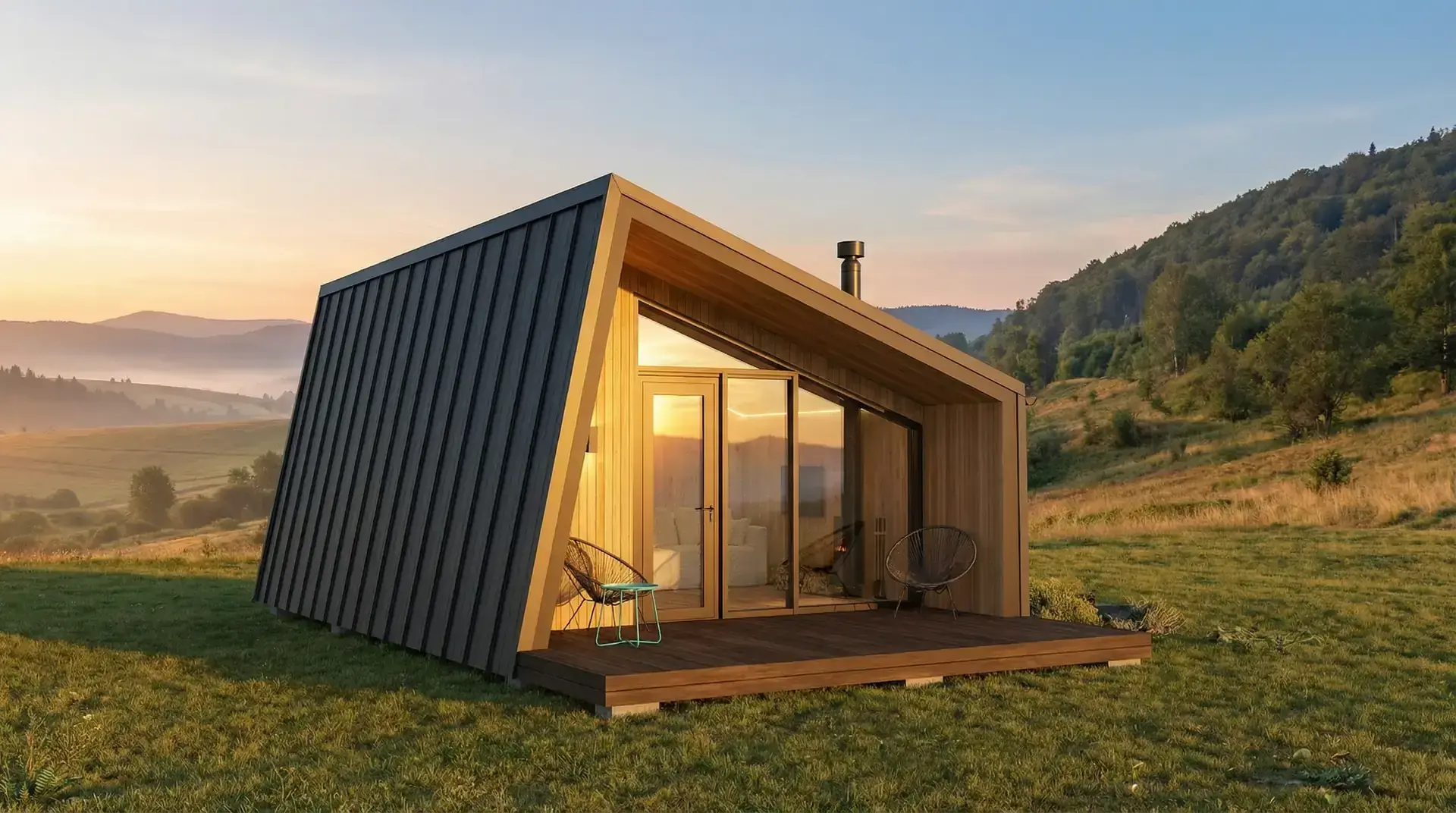
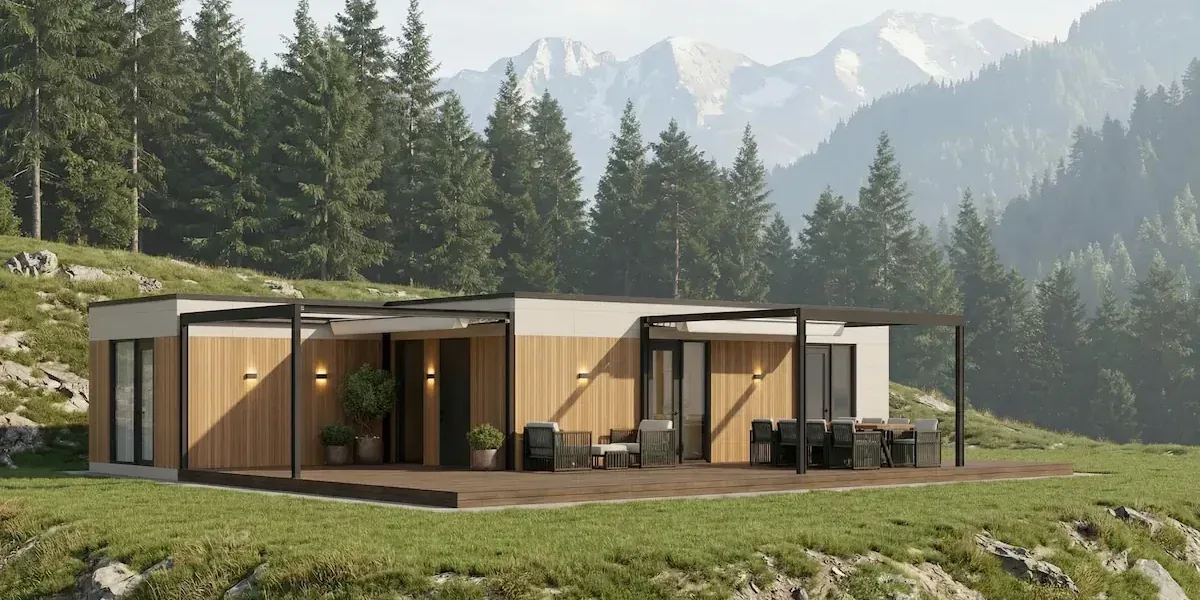
Practical country scenario
A buyer in Spain might start with a compact rental concept using Delta or Sofia. Before ordering, the buyer should confirm whether the plot allows tourist accommodation, how wastewater will be handled and whether a modular unit is treated as a building, temporary structure or accommodation asset.
Documents and local verification workflow
The local verification workflow should be documented. Prepare a simple site plan, intended use, selected QHOME candidates, dimensions, utility concept, access route and installation method. Then ask the municipality or licensed consultant which classification applies in Spain. The same unit can be read differently depending on permanence, connections, land category and whether guests pay to stay.
Keep written notes from each consultation. If the project changes from private use to tourism use, repeat the check before ordering. A compact Delta may have an easier first discussion than a large family model, but no model should be assumed automatically permitted.
Permit checklist
The table below gives a practical comparison lens for this topic. It is not a substitute for a site-specific quote, but it helps frame the first conversation.
| QHOME model | Use scenario | Local check | Transport / footprint |
|---|---|---|---|
| Delta | private plot | planning status | S/M: 26.2–38 m² + terrace |
| Sofia | tourism rental | tourism classification | 13.74 × 7.88 m |
| Mantra | campsite/glamping | utility availability | 10 × 14 m |
| QBBQ | service terrace | food/fire/service rules | 3.12 × 2.3 × 0.8 m |
Common mistake
The common mistake in Spain is assuming that a factory-built unit is automatically exempt from local planning rules. A modular home can still be treated as a building, accommodation unit or tourism asset depending on land status, connections, permanence, size and use. Check classification before choosing Delta or any other model.
QHOME-specific recommendation
For Spain, start with a two-track approach: a local permission check and a QHOME model selection. Do not freeze the module specification before the municipality or consultant confirms use, utilities and installation path.
- Delta — 26.2–38 m² + terrace, from €21,600; best fit: compact scenic modular home for couples, guest accommodation and glamping projects.
- Sofia — 78 m², from €46,600; best fit: single-storey home organized around a large terrace with two bedrooms and open social zone.
- Mantra — 104 m², from €64,200; best fit: premium single-storey family home with covered terrace and integrated one-car carport.
- QBBQ — 7.2 m², from €10,000; best fit: premium outdoor kitchen for terraces, villas, restaurants, campsites and hospitality projects.
- Alpina — 29.11 m², from €59,800; best fit: turnkey micro-chalet for glamping and hotel-room use with panoramic lounge and GearBox.
Decision checklist
- ask the local authority how a modular home is classified in Spain
- confirm land zoning and permitted use before paying for production
- check whether tourism use needs a separate operating permission
- verify road access, fire access, water and wastewater rules
- keep written decisions from the municipality or licensed consultant
Questions to ask before the quote
- How is a modular home classified on this land in Spain?
- Is the intended use private, rental, campsite, hotel or mixed?
- Which documents must be prepared before production starts?
- Are there utility, fire-access, environmental or tourism constraints?
- Who is responsible for local design sign-off and permit communication?
Reference notes
- QHOME.EU catalog — Product categories, areas, price ranges and scenarios.
- European Commission — Energy Performance of Buildings Directive — EU building energy performance context.
Frontier technology upgrades for modular home in Spain in 2026
The newest and most interesting technologies for modular home in Spain should be presented in three levels: available now, premium or limited, and watchlist. This keeps the article exciting without promising systems that are not yet bankable, serviceable or legal in the target country.
For remote land, the technical package must be designed as one ecosystem: energy, water, sanitation, internet and service access. The coolest device fails if it cannot be maintained locally.
What is worth mentioning now
| Technology | 2026 status | Why it is exciting | Main caution | QHOME fit |
|---|---|---|---|---|
| Smart rainwater harvesting with sensor-controlled first flush smart rainwater harvesting modular home | available / practical | Rainwater harvesting becomes more professional when tanks, first-flush diversion, filtration and level sensors are integrated with the modular project. | potable use rules vary by country | Mantra, Sofia, Alpina, Delta |
| Compact greywater recycling / MBR system greywater recycling modular home | premium / site-dependent | Greywater recycling is becoming more important as water scarcity rises; compact MBR or filtration systems can reuse shower/sink water where permitted. | health rules and local approvals vary | Mantra, Sofia, Delta, Magnum |
| Compact reverse-osmosis desalination desalination modular home | available / site-dependent | For islands and coastal projects, RO desalination can be relevant, but it is energy-, maintenance- and brine-sensitive. | brine discharge and energy demand must be handled legally | Alpina, Delta, QBBQ, Magnum |
| Tank telemetry and AI leak detection water telemetry modular home | available / practical | Remote water telemetry prevents the classic off-grid failure: a guest arrives and the tank, pump or filter has failed unnoticed. | alerts must trigger real service action | Alpina, Delta, QBBQ, Mantra |
| MOF atmospheric water harvesting atmospheric water generator modular home | emerging / watchlist | MOF-based water harvesting is one of the most futuristic water topics: it can extract moisture from air, but current serious systems are not yet a normal small-home utility item. | cost, maintenance, climate performance and water quality verification are critical | Delta, Magnum, Alpina |
Do not oversell the future
The safest editorial rule: if a technology is a pilot, lab record or infrastructure concept, describe it as a watchlist option. Do not put it into a buyer checklist until the supplier, warranty, installation route and local approval are clear.
- Smart rainwater harvesting with sensor-controlled first flush: Installing a tank without first-flush, overflow and maintenance access.
- Compact greywater recycling / MBR system: Marketing greywater as universally reusable without checking local rules and treatment level.
- Compact reverse-osmosis desalination: Treating desalination as free water because the sea is nearby.
Decision checkpoints before adding frontier tech to a quote
- Smart rainwater harvesting with sensor-controlled first flush: Design catchment, treatment, use case and legal status together.
- Compact greywater recycling / MBR system: Use greywater only with clear permitted end uses, monitoring and service plan.
- Compact reverse-osmosis desalination: Use only after water source, brine route, energy and maintenance are confirmed.
- Tank telemetry and AI leak detection: Define alarm thresholds, owner, response time and spare parts.
- Separate “available now” items from “future-ready” preparation in the article and in the commercial conversation.
- Confirm local installer availability, service response time and warranty transfer before recommending the system to a private buyer or hospitality operator.
QHOME-specific recommendation
Resilience scenario: use Mantra, Lumen or Alpina with solar-ready routing, a monitored LFP battery, rainwater telemetry and a clear sanitation pathway. Keep perovskite, sodium-ion and MOF water harvesting as watchlist upgrades unless locally available.
Reference signals behind this 2026 technology layer
- European Environment Agency — Water scarcity conditions in Europe
- European Commission — Circular systems can drive reductions in city freshwater use
- AP — Desalination is a growing drinking water source
- The Guardian — MOF-based water harvesting from dry air
FAQ
Do I need permission for modular home in Spain?
Usually this must be checked locally. In Spain, the answer depends on land classification, permanence, utilities, footprint, private or tourism use and municipal interpretation.
Can a QHOME modular home be used for tourism in Spain?
It may be possible, but tourism use can trigger separate registration, classification, fire access, parking, wastewater and operating rules. Confirm this before ordering a unit such as Delta or Sofia.
Which QHOME models are safer for an early legal review?
Compact models such as Delta, Sofia or Mantra are often easier to discuss because footprint and transport are clearer, while larger models need deeper review of planning, access and utilities.
Should I buy land before choosing the module?
Land should be checked before final model selection. The plot determines access, permitted use, foundation, utilities, fire access, views and the practical business model.
Who should confirm the legal path?
A local architect, planner, municipal authority or licensed consultant should confirm classification and required documents. This article is a checklist, not legal advice.