
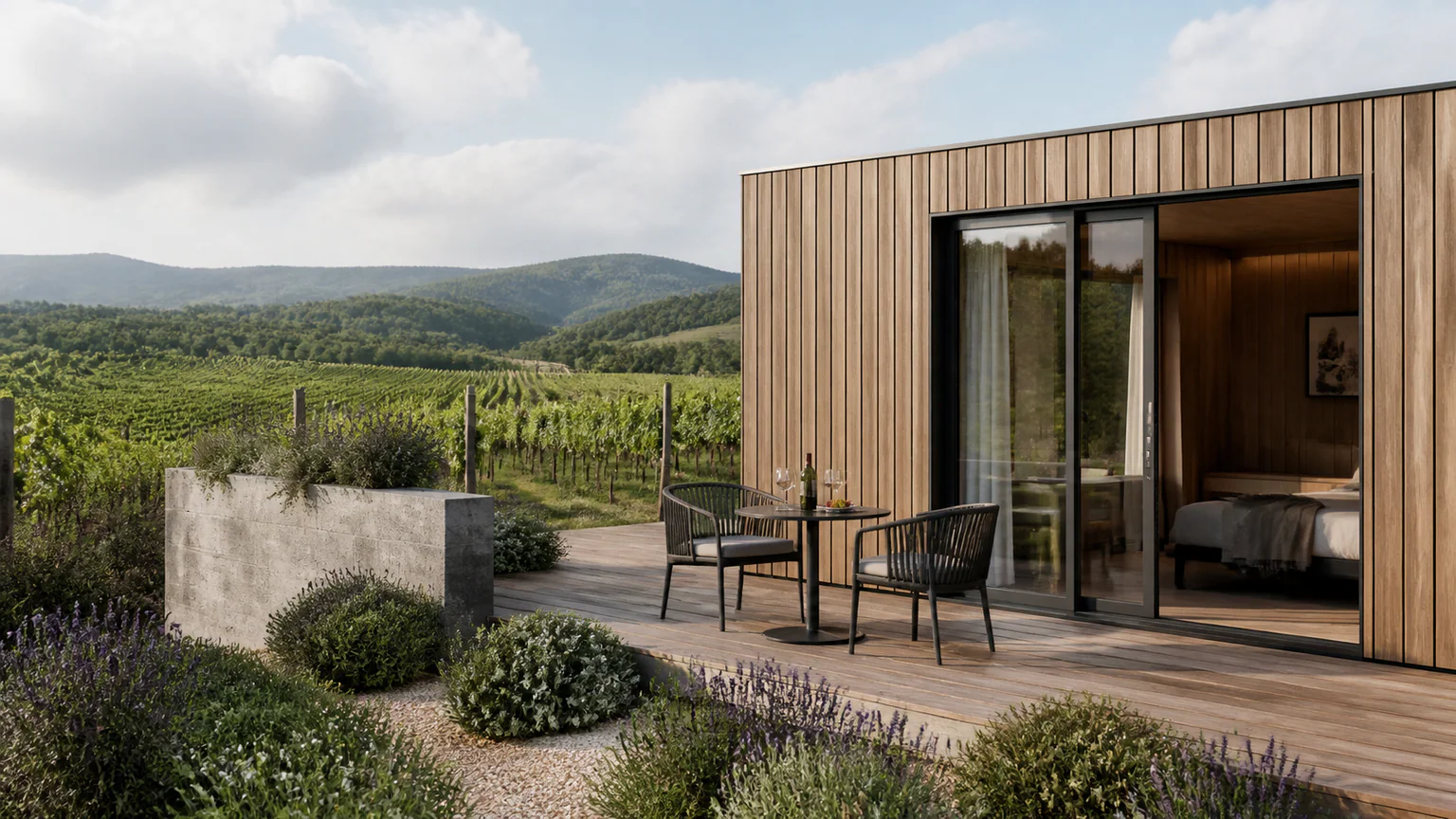
Guest promise and business model
modular homes for wine tourism starts with a promise to the guest. Is the stay about a mountain view, a quiet forest retreat, a wine weekend, a pool terrace or a family nature break? A room mix based on Zephyr, Sofia and QBBQ can support different positioning levels and stay lengths, while Alpina adds a food and atmosphere layer.
Why modular changes the project planning
Factory production allows the operator to prepare land, brand, booking pages and service procedures while units are being produced. That parallel workflow can protect the opening season.
Room mix and site operation
Compact units such as Zephyr and Sofia work well when the goal is room count and scenic privacy. Mid-size units such as QBBQ or Delta fit family stays, longer bookings or premium zones. The site plan should separate arrival, service routes, quiet terraces and shared amenities.
Operational details that affect reviews
Guest reviews often come from basics: clean bathroom, stable temperature, easy check-in, privacy, dry paths, lighting and a place to prepare or enjoy food.
Practical hospitality scenario
A ten-key nature resort might open with six Zephyr rooms, two larger QBBQ family units and one Alpina service point. This mix lets the operator test couples, families and event bookings before adding a second phase.
Launch workflow for the operator
A practical launch workflow starts with the site story, not the house count. Map arrival, parking, paths, views, privacy, shared amenities and service routes. Then select the room mix: compact units such as Zephyr, scenic rooms such as Sofia, family units such as QBBQ and an outdoor service point where QBBQ can create food and atmosphere.
Before opening, test one complete guest journey: booking confirmation, access code, room temperature, luggage path, shower, evening lighting, breakfast or BBQ scenario, cleaning time and check-out. If that journey works, scaling is much safer.
Comparison table
The table below gives a practical comparison lens for this topic. It is not a substitute for a site-specific quote, but it helps frame the first conversation.
| QHOME model | Area | Calculator quote | Best use |
|---|---|---|---|
| Zephyr | 84 m² | price and packages on the product page | permanent living |
| Sofia | 77.86 m² | price and packages on the product page | guest accommodation |
| QBBQ | 7.2 m² | price and packages on the product page | glamping / hospitality |
| Delta | 36 m² + terrace | price and packages on the product page | outdoor revenue |
What to avoid
The common mistake is maximizing room count before designing the guest journey. A site full of Zephyr or Sofia units can still underperform if terraces lack privacy, cleaning routes are inefficient, check-in is unclear and there is no food, sauna, QBBQ or outdoor experience to support the nightly rate.
QHOME guidance
For hospitality, QHOME selection should be built around the guest promise: view, privacy, bed comfort, bathroom quality, self check-in and a memorable outdoor moment.
- Zephyr — 84 m²; price and packages on the product page; best fit: architectural home with light vertical facade, dark accents and outdoor living area.
- Sofia — 77.86 m²; price and packages on the product page; best fit: single-storey home organized around a large terrace with two bedrooms and open social zone.
- QBBQ — 7.2 m²; price and packages on the product page; best fit: premium outdoor kitchen for terraces, villas, restaurants, campsites and hospitality projects.
- Delta — 36 m² + terrace; price and packages on the product page; best fit: compact scenic modular home for couples, guest accommodation and glamping projects.
- Alpina — 44.76 m²; price and packages on the product page; best fit: turnkey micro-chalet for glamping and hotel-room use with panoramic lounge and GearBox.
Your decision checklist
- define the guest segment and nightly rate before room count
- match module type to cleaning, linen and maintenance flow
- place terraces for privacy, not just for view
- add food or outdoor-service revenue where it improves guest spend
- launch in phases when land demand is still unproven
Questions before you request a quote
- Which QHOME models should be compared for modular homes for wine tourism, and why?
- What is included in The quotation, and what is project-specific?
- What site information is required before a reliable offer?
- Which utilities, smart systems and outdoor additions should be planned now?
- What assumptions could change delivery, installation or operating cost?
Sources and further reading
- QHOME catalog — Current models, planning information and product links.
- Grand View Research — Europe Glamping Market Outlook — European glamping growth context.
- Mordor Intelligence — Europe Prefabricated Housing Market — European prefab housing market sizing and growth context.
FAQ
Is modular homes for wine tourism profitable?
It can be profitable when land cost, ADR, occupancy, utilities, cleaning, maintenance and marketing are realistic. The strongest projects design the guest journey before buying units.
Which QHOME model is best for glamping?
Zephyr, Sofia and QBBQ are strong starting points. Use compact units for room count and add larger or service modules when the site needs family stays or outdoor revenue.
How many units should I start with?
A phased launch is often safer: start with enough units to test demand and operations, then add more modules once occupancy and guest reviews are proven.
Do I need smart locks?
For remote or multi-unit hospitality, smart locks are highly practical because they reduce manual check-in work and support automated guest access.